In the previous article, we looked at the concept of divergence and the original concept as outlined by Charles Dow in his Dow Theory. We learned that the concept of divergence applies to any market and can be used to compare two securities, such as the Dow Jones Industrials and the Dow Jones Transportation indexes. In this article, we will guide you on trading with divergence by explaining how divergences form in the context of the forex markets and relative to indicators, and outlining the different types of divergences.
The Concept of Divergence in the Forex Markets
In the forex markets, or, for that matter, in futures or stocks, divergence is often related to the price and the oscillator tracking it. Divergences can be spotted using oscillators only, and among the many oscillators, MACD, Stochastics, RSI, Awesome Oscillator, CCI, and Williams %R are among the most commonly used.
An oscillator is used to track the overbought and oversold prices. Because most oscillators are based on price, relative momentum, or volume, they are the best choice for understanding price momentum, which signals how strong the prevailing trend is.

When prices reverse or retrace, the oscillator tends to follow the same pattern. Therefore, when prices make higher highs or higher lows, the oscillator tends to mirror the same pattern. Conversely, when prices make lower highs and lower lows, the oscillators tend to print lower highs and lower lows. This is what we already knew as convergence.
When price makes a high or a low and the oscillator fails to confirm the same, it is known as divergence. By spotting these divergences, traders are usually signaled to a potential change in price direction.
How Are Divergences Formed?
Divergences form when there is a mismatch between price action and momentum, as measured by the oscillator’s relative position to price. Quite often, you will notice that divergences tend to occur near support and resistance levels.
Therefore, divergence trading can be used not only to time the entry into a trade within a trend, but it can also help you to understand support and resistance levels. While divergences are broadly classified into 4 types, the underlying theme across all 4 is that they indicate price exhaustion when the oscillator fails to confirm new highs or lows.
Divergences take place all the time and across all time frames. However, the best results come when divergence is spotted on higher time frames, such as 4-hour sessions or higher.
One of the most common mistakes in divergence trading is expecting the price to behave in a certain way when a divergence is spotted. This is wrong! Just because a divergence is formed doesn’t mean that the price will reverse. In the charts that are outlined in this article, you will find a few divergence setups where the price moved in the opposite direction, contrary to what the divergence was telling you.
It is therefore important to understand that traders should consider other confirmation tools (which will be covered in a later article) before trading divergence setups.
Types of Divergences
There are 4 types of divergence, which are broadly classified into two categories:
- Regular or Classic Divergence
- Hidden Divergence
With each of these two categories, you have a bullish or a bearish divergence. Therefore, the four types of divergences are summarized as:
- Regular Bullish Divergence
- Regular Bearish Divergence
- Hidden Bullish Divergence
- Hidden Bearish Divergence
The chart below provides a quick overview of the 4 types of divergences mentioned above.
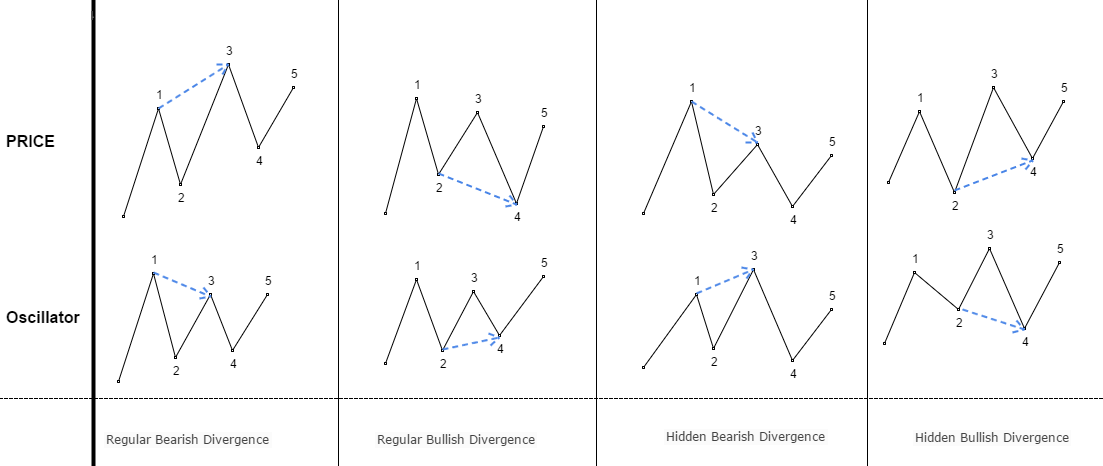
Divergence Table (Price and Oscillator)
| Price | Oscillator | Divergence Type |
| High -> Higher High | High -> Lower High | Regular Bearish Divergence |
| Low -> Lower Low | Low -> Higher Low | Regular Bullish Divergence |
| High -> Lower High | High -> Higher High | Hidden Bearish Divergence |
| Low -> Higher Low | Low -> Lower Low | Hidden Bullish Divergence |
Examples of Bullish and Bearish Divergence
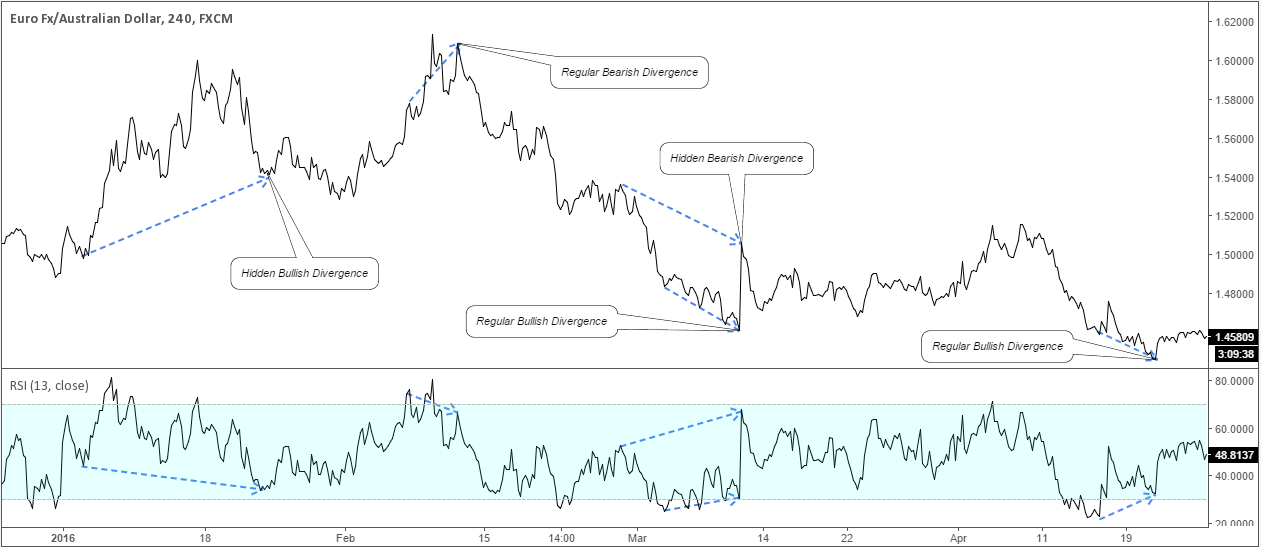
The following two charts show examples of the four types of divergences described above. In the examples, we make use of the Stochastics oscillator. But feel free to experiment with other oscillators mentioned earlier in this article.
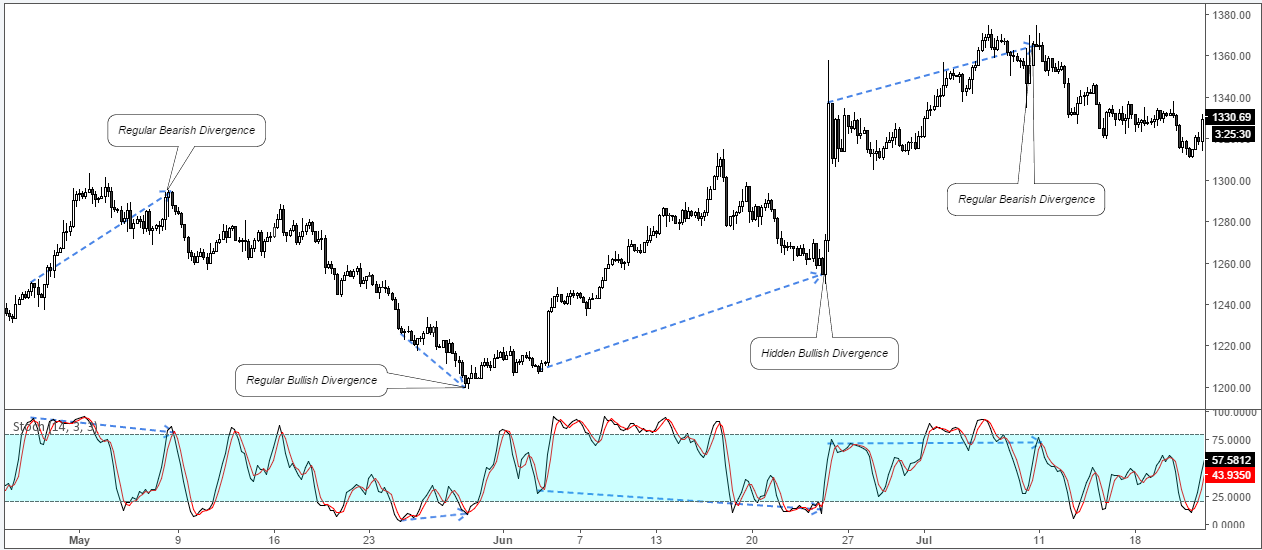
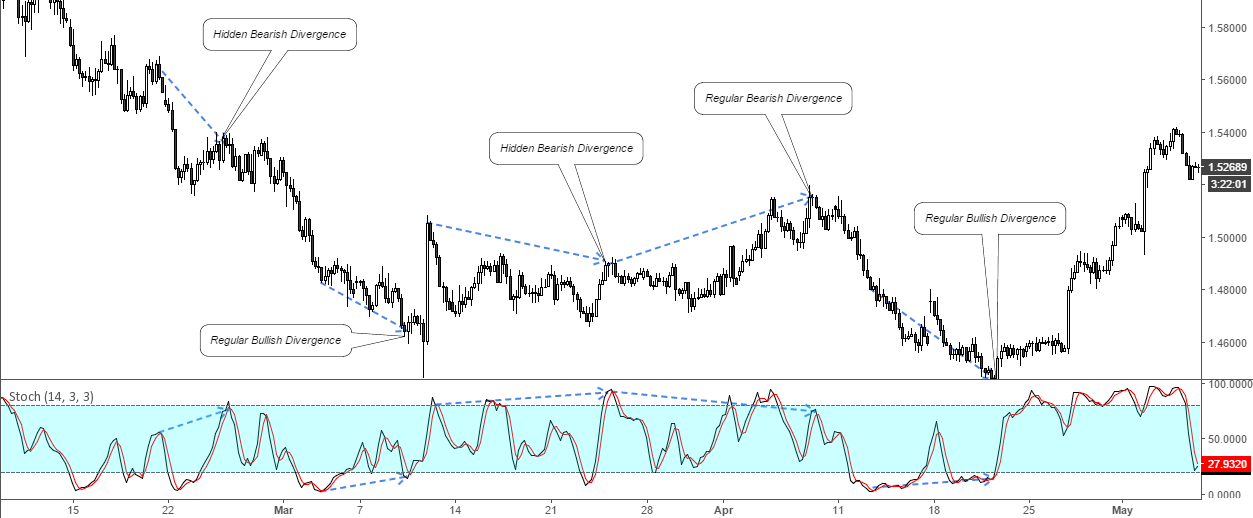
Spotting divergence takes time and does not expect results overnight. The best way to get started with spotting divergence is to use one of the many custom divergence indicators that are available for MT4. These automated indicators spot divergence for you, which can serve as a good starting point for understanding the highs and lows. In terms of which oscillator to use, the RSI makes for an ideal oscillator to train your eye to spot the divergences. Simply switch the price chart to a line chart, then add the RSI to make it easier to train your eye.