


The run-up to every presidential election, including the upcoming US Presidential Election, is usually a volatile one. Both candidates reveal their strategies for the next four years to tempt voters into their camp. Markets usually await traders’ sentiments to see which direction they will go.
But there is something even more interesting about this election. For the first time in over 50 years, the current President, Joe Biden, has decided not to run for a second term. In addition, Donald Trump aims to be part of a small group of ex-presidents who hope to be re-elected to win a second non-consecutive term.
With this, there are certain aspects of history repeating itself since America has seen what four years of a Trump office would bring to the economy and the markets. In particular, the Trump Trade.
The Trump Trade

So, what exactly is the Trump Trade? Well, it’s not an actual singular trade. It’s a collection of investor opinions based on whether the former President gets re-elected and how it could impact some markets.
Tax cuts, deregulation and more fiscal spending were all trademarks of the first Trump presidency. Investors expect these policies to come back if he wins again.
If Donald Trump does get his seat back in the White House, some economists believe it could mean that the Fed might be hesitant to cut rates, given that potentially higher deficit spending might drive up inflation. With the recent speculation that the Fed will continue loosening its monetary policy, higher tariffs could lead the FOMC to think twice about a regular cut in rates.
In a nutshell, The Trump Trade reflects the expectation of a pro-business climate in light of the US Presidential Election.. The shift in market behaviour and trader sentiment in response to political moves are all associated with a potential Trump presidency.
What Markets Can be Affected?
Stocks were a primary mover, especially in tech, financials, industrials, and energy, and they saw significant gains during Trump’s previous term. The Tax Cuts and Jobs Act, which was signed into law at the end of 2017, reduced corporate tax rates and was a significant win for tech companies, leading to increased investments, dividends and stock buybacks.
In addition, the S&P500 rallied nearly 50% from Trump’s election until the beginning of the 2020 pandemic. The index also saw a complete reversal of the Covid correction, which saw over a thousand points wiped off its value. The greenback also saw some appreciation against its main competitors, which was driven by expectations of strong economic growth.
So, can we expect the same again? Well, what if Kamala Harris becomes President?
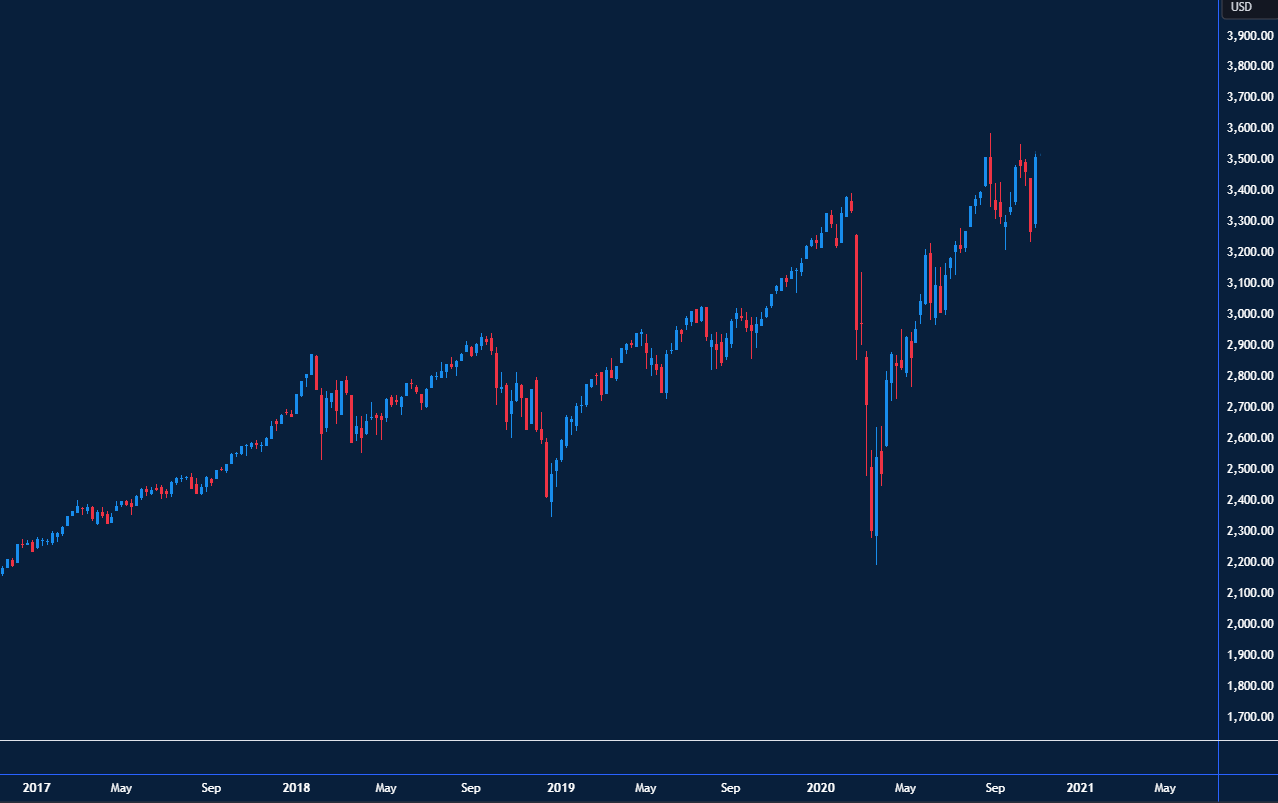
The S&P rallied from the start of the Trump administration until the pandemic began in 2020
Is There a Harris Trade?
If Harris wins the US presidential election, markets could initially react with caution due to potential increases in corporate taxes and more regulations. So, what sectors could benefit from a Democratic win?
A Harris administration could enhance prospects for clean energy, as Joe Biden’s green future push shows a move away from fossil fuels. Investors might see gains in renewable energy, with companies specialising in solar, wind, and other sustainable energy sources, which could yield considerable returns and more investment in electric vehicles.
Oil and gas companies might face some resistance under a Harris administration, as we have previously heard that fossil fuel usage is looking to be a thing of the past. With that being said, the sector has performed exceptionally well under the current administration. Chevron and Exxon Mobil, for example, have reported record profits, and American oil production has hit record levels.
With Trump’s pledge to ‘drill baby drill’, you could say that this sector will continue to thrive regardless of who wins in November.
However, if we look back on the previous Trump term, it was not just his speeches that caused controversy; it was also his Twitter posts.
Was Trump Moving the Markets with his Tweets?
It’s safe to say that Donald Trump was the first ever President to have such an active social media presence. But was his Twitter habit more strategic than we think? Averaging around ten tweets a day, the former President did not hold back when commenting about trade tariffs with China or his continuous criticism of Fed Chair Jerome Powell.
When the ex-president shocked the markets by announcing on Twitter that he would raise tariffs of 10% on $200 billion to 25%, this sent the Dow lower by 300 points. It also affected Chinese purchases of US agricultural products such as soybeans and cotton.
Therefore, traders will need to keep an active eye on future social media posts, as it is not just the greenback that moves.
Whilst an active Trump on his own media platform, Truth Social, can disrupt markets, he has still been suitable for the stock market overall. The Dow was up over 50% since the 2016 inauguration, which is the best performance for any Republican president for over 100 years.
However, it’s not just stocks and indices that traders should focus on, as other asset classes are moving.
How About Bitcoin?
Both parties have made a notable pivot toward pro-crypto policies. But one candidate is more than the other. Once a vocal critic, Trump has emerged as a believer in this election and even announced that he would accept donations in crypto.
Bitcoin’s reaction to Trump’s first term saw a meteoric rise in price action. Since November 2016, BTC was trading at just over $700, and by the end of 2017, it had jumped close to $20,000. Even recently, the price of bitcoin jumped more than 10% after Trump was injured during an assassination attempt, as the assumption pointed to him winning the election at the time.
This is because the Republican is seen as the more pro-crypto candidate, having hosted industry executives and voiced enthusiasm for US-based bitcoin mining, stating that if crypto is going to define the future, I want to be mined, minted and made in the USA.
The Democrats’ approach remains less supported. Kamala Harris previously signalled a desire to reset relationships with the industry, which could cause concern amongst traders if she is elected. With over 50 million Americans holding crypto, that’s a significant voting bloc that both parties will be looking to please.
The expectation of further interest rate cuts in the near future could be a driving factor for more investment into crypto, along with changing generational attitudes that view Bitcoin as a viable alternative to cash. As currencies remain pressured, cryptocurrencies could increasingly be seen as a haven and a hedge against economic uncertainty, much like gold.
So, with Bitcoin hitting a record high above $73k in March, will traders witness a test at $100k by the end of the year?
As the campaign progresses, it will be crucial to watch for statements or policy proposals regarding cryptocurrency and blockchain technology. Their approach could significantly impact the regulatory landscape for the industry, which could cause another record high or a possible deep correction.
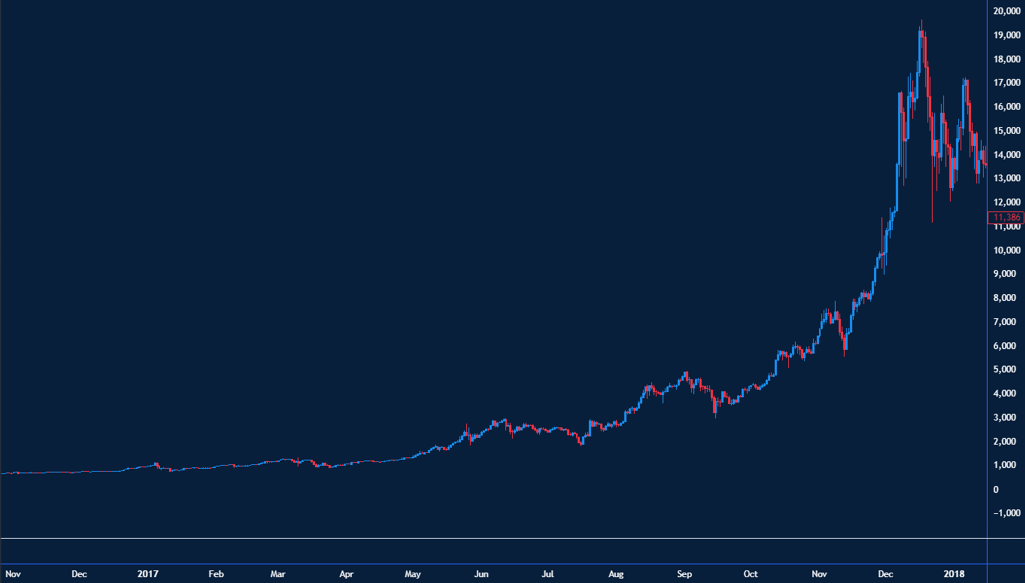
Bitcoin rallied to test $20k in the first year of the Trump Administration
So, Harris or Trump?
In essence, traders will be eager to know what markets will be affected for both candidates. With a recession avoided so far, a soft landing is in focus as the Fed weighs up the next rate cut.
With more funds expected to be injected into the economy under Trump’s ‘Make America Great Again’ slogan, tech companies are expected to continue their rallies. Trump’s core policies, such as tax breaks and tariffs, would be viewed as inflationary, which would pump up the value of the dollar and, in turn, force the Fed to keep rates higher, which would also raise the status of the currency markets.
A Harris win could see the stock markets continue higher. Being under the same Democratic party might not show too much volatility since the Dow, Nasdaq, and S&P have all been hitting record after record under the Biden administration. So it could be a case of more of the same.
Whilst the 2024 election will undoubtedly influence the market, inflation and fiscal policies, amongst others, will play significant roles in where price action will be heading for the next four years. With the US Presidential Election right around the corner, traders will be watching closely at the first signs of volatility.


![Credit Card 160×600 [EN]](https://assets.iorbex.com/blog/wp-content/uploads/2023/06/13144507/Blog-Banner_EN-Banner_160X600X2.webp)


