


Risk On, Risk Off.. or RoRo as its commonly called, is probably an important term widely used in the financial markets, regardless of what assets one is trading. Depending on how the underlying sentiment prevails, traders can use this information to their advantage and thus be able to position themselves accordingly.
What is market sentiment?
Trading is mostly based on sentiment or what investors feel. When investors are bullish, they tend to take on more risk. Also known as “Risk-On sentiment”, in this scenario, investors prefer to shun low-yielding assets and instead buy up the riskier, volatile, and high-yielding markets. For example, a typical risk-on sentiment is often reflected in equity markets pushing higher, while low-yielding, safer assets such as US Treasuries see a decline.
Alternatively, when investors start to feel cautious about the markets, they tend to scale back their bullish bets and instead opt for the safe or low-yielding assets, such as the US treasuries, while selling off their stake in the risky assets, such as stock markets.
Why does the market shift between risk on and risk off?
The reasons are many. For starters, risk on is typically observed during periods when investors feel confident and there are no significant risks. For example, a strong US jobs report is often accompanied by gains in the stock market, all things being equal. Likewise, disappointing jobs or GDP data could usually signal a risk-off sentiment. However, it is not that simple. Many factors shape the forex sentiment chart and are often not limited to just one geographic region or economy.
A notable example is the recent market selloff triggered by China’s weak data earlier this year. Equity markets (often considered risky but high yield) plunged across the board while safe-haven assets fared better under the circumstances.
Applying Risk-On Risk-Off to the Forex markets
With a fair understanding of market sentiment, let’s examine how the RoRo applies to the currency or forex markets. Firstly, among the major G8 currencies (AUD, USD, CHF, GBP, EUR, JPY, NZD, CAD), there are significant categories in the currency sentiment meter that determine them as either a ‘Safe Haven’ or a ‘Risky Currency’, summarized in the table below.
Safe Haven Currencies Risk Currencies
USD AUD
JPY NZD
CHF CAD
Risk-On Sentiment: AUD, NZD, and CAD tend to outperform the safe haven currencies
Risk-Off Sentiment: USD, JPY, CHF tend to outperform the risky currencies.
*Note: The US Dollar’s performance is mostly neutral, but in strong risk-on sentiment, the Dollar tends to rise strongly.
How to determine market sentiment before starting your trading day?
- Start with the Asian markets (if you are trading the European/US session) and/or look to how the US markets closed the previous day.
2. If you notice the markets being sold off strongly, most importantly, the Nikkei225 and the US S&P500 and the Dow Jones Index chances are that a Risk-Off sentiment is prevailing and, therefore, Yen, CHF are likely to outperform AUD, NZD and CAD. Alternatively, if the US and Asian equities closed with strong gains, the market is in a Risk-On sentiment then the AUD, NZD and CAD will outperform the safe haven currencies, Yen and the CHF.
3. Of course, one should not trade blindly on the sentiment alone but also conduct individual assessment of the currency pairs before entering a position
4. Note that sometimes, market sentiments can reverse rather quickly within the day and this highlights the importance of doing a thorough fundamental and technical analysis on the currency pairs.
5. Gold is also an important indicator of risk sentiment. Gold prices tend to rise mostly on rising geopolitical tensions and market uncertainty.
6. A special note on EURUSD. When the German DAX is down following its peers, the Euro tends to rally to the Dollar.
Market Sentiment – Chart Examples
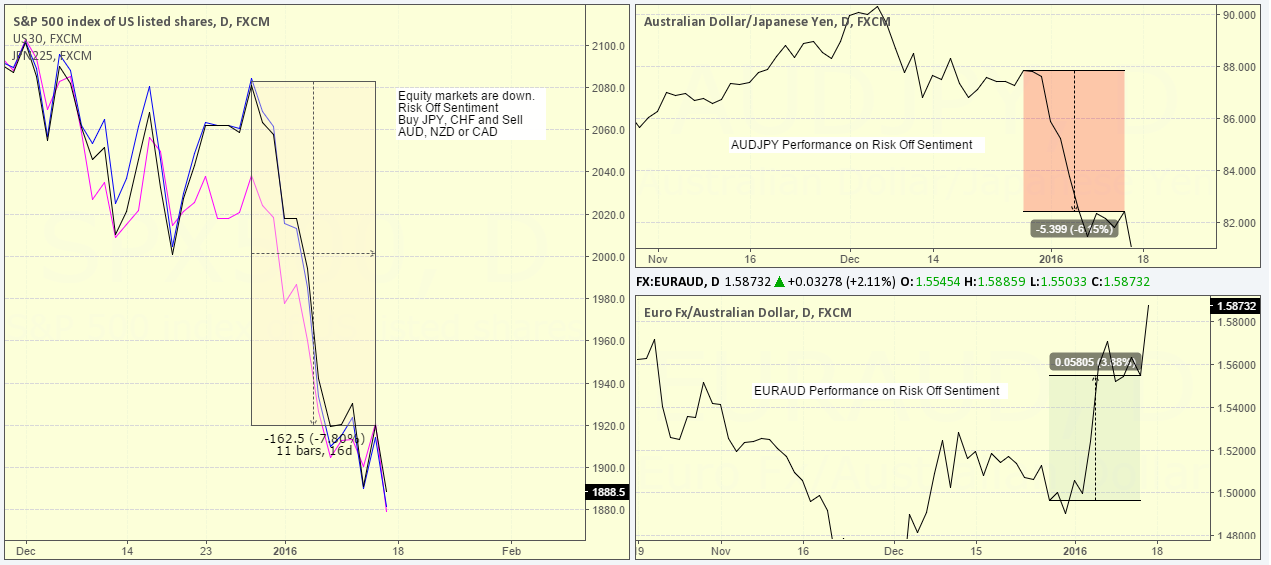
Risk-Off Sentiment
• Equities fall (Nikkei225, Dow Jones, S&P500)
• JPY outperforms AUD risk asset
• EUR outperforms AUD risk asset
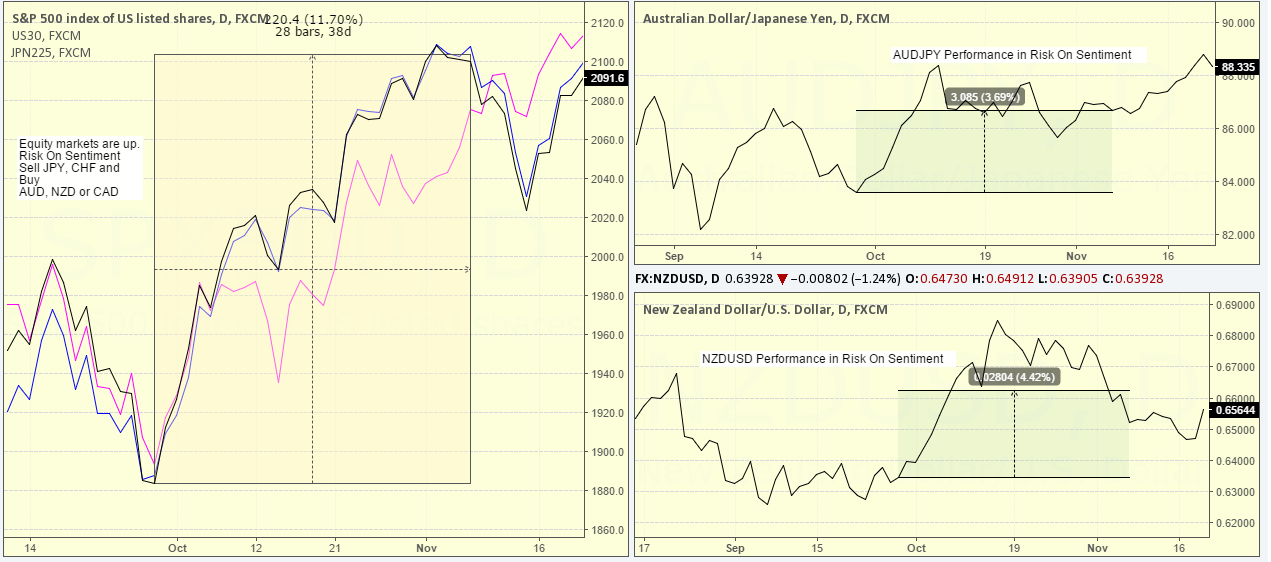
Risk-On Sentiment
• Equities rising
• JPY turns weak as risk currencies gain
• NZD outperforms USD, AUD outperforms JPY
Gauging Market Sentiment – Conclusion
As illustrated, understanding market sentiment can help traders to better position themselves and also helps traders to pick the currency pairs that are most likely to offer big gains. The market sentiment is nothing but Inter-market analysis and with due practice, traders would be able to tell which way the ‘wind’ is blowing and thus be able to make money in the forex markets regardless of how the markets perform.