

When looking at the main fundamental news events that can flip a market on its head, it’s important to go straight to where the action is. Jobs, interest rates and inflation are main key economic indicators that significantly influence the financial markets.
So, let’s take a closer look how each of these indicators impacts stocks, equities and the broader financial market.
How are job numbers a key indicator?
Probably the biggest market mover on a consistent basis is the release of the Non-Farm Payrolls. On the first Friday of every month, except for public holidays, America unveils its highly anticipated job number, usually creating volatility across the board, especially with gold and dollar FX pairs.
High unemployment often signals signs of economic slowdowns which can lead to a possible recession. During this period, consumers tend to spend less, lowering corporate profits which usually tends to drag stock prices lower.
On the flip side, low unemployment suggests strong economic growth, higher consumer spending which is usually positive for corporate earnings and the stock market.
If we take a recent example of the 2020 pandemic, the surge in unemployment was felt globally, especially in America, where the percentage jumped over 10% in a few weeks, something which hasn’t been seen in over 50 years.
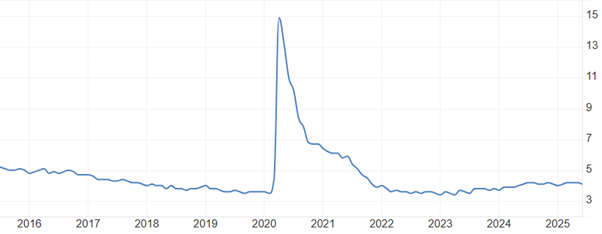
Unemployment soared towards 15% in America when the Covid-19 pandemic began
During this time, central banks lowered interest rates and initiate stimulus to support the markets and prevent a worldwide depression. With lockdowns persisting, millions unemployed and consumer spending plunging, nations had to act fast to protect their economies from collapsing.
So where do Interest rates come into play?
These are set by central banks e.g. Fed and the ECB to control inflation and stabilise the economy.
With the talk of interest rates rising and falling in recent years, just what are the implications?
Well high interest rates increase the borrowing costs for consumers and businesses, so less is borrowed or spent, leading to a decrease in corporate profits. Stocks usually react negatively to this whereas the value of a country’s currency tends to strengthen.
Demand for the currency becomes more attractive as investors see it as a clear sign to make money. Going back to the pandemic as an example, when the US were raising interest rates time and time again, most economies were remaining cautious. This is why we saw such a decline on the EURUSD currency pair during this period, because the Fed was one of the first central banks to take action and aggressively raise rates, breaking parity in the process.
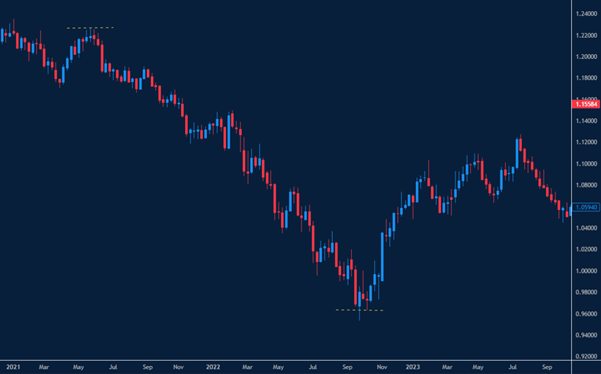
During the majority of 2022 and 2023, the dollar jumped over 1000 pips against the Euro
Investors sold Euros to buy Dollars to take advantage of the higher dollar return. This increased the demand for the greenback to strengthen against the Euro and most of its competitors.
On the flip side, a fall in interest rates encourages more borrowing which leads to more spending, boosting activity. However, conversely to rising rates, the home currency tends to fall lower, as it becomes a less desirable investment.
What about Inflation?
We’ve all seen how prices for goods and services have risen over time, and the higher the inflation, the more we see a reduction in the purchasing power for consumers due to rising costs. Company margins are squeezed and there is the worry of central banks moving their interest rates higher to control inflation.
It is a bit tricky when it comes to inflation, because an economy having low inflation indicates a sign of stagnation, which is when there is no room for growth, as GDP and employment as well as a host of other indicators fall lower.
What is more targeted by central banks is moderate inflation which sits in the middle. This often reflects a steadily growing economy which supports the equites and stocks, mainly automotive, construction and hospitality.
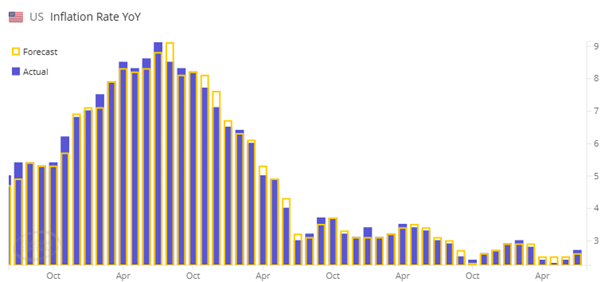
Inflation hit a 40 year high to reach 9.1% at the height of the pandemic in the US
What other markets are affected?
We previously touched on currencies to state that rising interest rates attracts foreign capital, in turn reinforcing currencies.
However, it’s not all about the forex pairs. When unemployment is low, this drives demand for stocks and equities since more consumer spending leads to higher revenues. Stock prices move higher which also boosts indices.
Sectors that are sensitive to rates popping higher include tech and real estate, since this environment has a high reliance on future cash flows and borrowing.
Commodities such as gold and oil are also where traders see many opportunities to cash in. When inflation fears are heightened, gold is usually hedged against currencies like the US dollar, and often rises in times of uncertainty and high inflation.
Bottom Line
Traders are always looking out for the next opportunity in market, but it can actually be quite simple. Should another high impact news event such as a pandemic or a trade war begin, jobs, inflation and interest rate decisions are always at the forefront of the markets.
Should these three economic indicators get affected, then the markets can provide some great returns, as we have seen in the past.
Even if the economy falls into a recession, for every downturn there is usually a recovery that includes a strong rebound. Focus and invest on what assets could benefit from a recession, such as Gold and consumer staple stocks that consists of essential products that will always be in demand.
Once you have those patterns in mind, then a recession will not seem like such a detrimental experience, and neither will a drop in employment, inflation or interest rates.